F
FoundSquare
This guide is also available for:🇺🇸 United States🇳🇱 Nederland
Manufacturing & Import

How to Start a Digital Signage Business in the UK (2026): Costs, Profit and 4 Ideas

Start a digital signage business in the UK with £1,215-£3,235. Import screens from China and sell them installed to high-street shops, cafés and estate agents at 40-60% margins. Work out your profit with our calculator.

Mark de Vries
Hospitality & Sourcing Lead
Published Updated 12 min read

FoundSquare is reader-supported. We may earn a commission when you buy through links to Alibaba or other retailers on this page, at no extra cost to you. Our policy.

Walk down any UK high street and count the screens. Digital menu boards in takeaways, property listings in estate agents' windows, promotional stands in shopping centres. They're everywhere. And someone sells them to the shops and cafés.

That someone could be you. Import a basic 32-inch display for as little as £195, or a full 86-inch 4K floor-standing unit for around £650. Sell it installed and set up to a local café for £1,280-£1,700. Margins are 40-60% because you're not just selling hardware. You're selling the whole solution: the screen, the setup, the content management, and the peace of mind that it works.

Starting capital? Between £1,215 and £3,235 gets you a few demo units, import costs, a basic website and insurance. Compare that to almost any other B2B business. Here's how the numbers work.
The short version
  • Start a digital signage business in the UK for £1,215-£3,235 in initial capital.
  • Import displays from China at £195 for a basic 32-inch unit, up to £650 for a flagship 86-inch 4K floor-standing display.
  • Sell installed at £1,280-£1,700 to cafés, takeaways, shops and estate agents. Margins of 40-60% because you cut out the UK distributor and the local reseller.
  • Break even in 3-6 months if you close 2-3 deals a month. One shopping-centre order for several screens can cover the whole year.
£1,215-£3,235
Startup Cost
40-60%
Profit Margin
3-6 months
Break-Even
£2,150-£6,800/mo
Est. Monthly Profit

UK businesses search for digital signage every month. "Digital signage" gets about 1,300 monthly searches in the UK, "digital signage display" and "digital menu board" 590 each, and "digital signage software" 260. Demand peaked in October and has eased since, but buyers are searching all year.

oct '25sep '26
↓ 32% YoYPeak: October
Top searches (monthly)
DataForSEO Google Ads, United Kingdom, Sep 2026 · Updated November 2026
"digital signage"1,300/mo"digital menu board"590/mo
commercialtransactionalinformational
Inspiration

How can you make money with this?

1

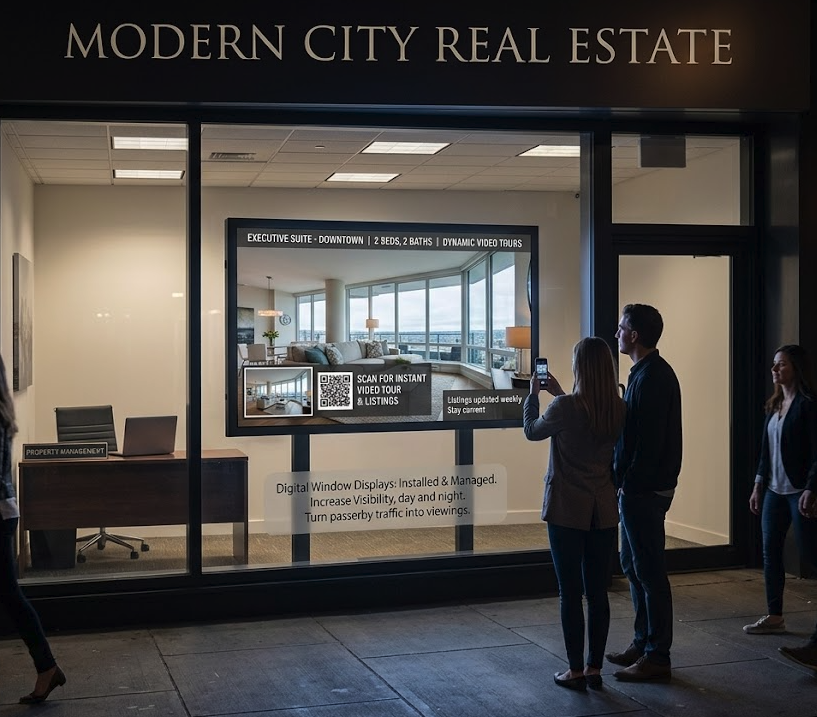
Digital window displays for estate agents

UK estate agents are always looking for ways to make their listings stand out on the high street. A high-brightness screen in the office window with video tours catches every passer-by, day and night.

StrategySell the screen with window installation, then offer a support subscription where you update their property listings remotely every week through the CMS.
Revenue modelHardware sale (one-time) + Service subscription (recurring)
The numbers
  • Hardware + installation: £1,490 sale (~£850 profit)
  • CMS & support: £40/month per agent
  • Goal at 5 agents: £4,250 one-time profit + £200/month recurring
Best forSomeone who wants recurring revenue. The monthly subscriptions add up fast and the sales conversation is short. Every agent already understands the value of better window listings.
2

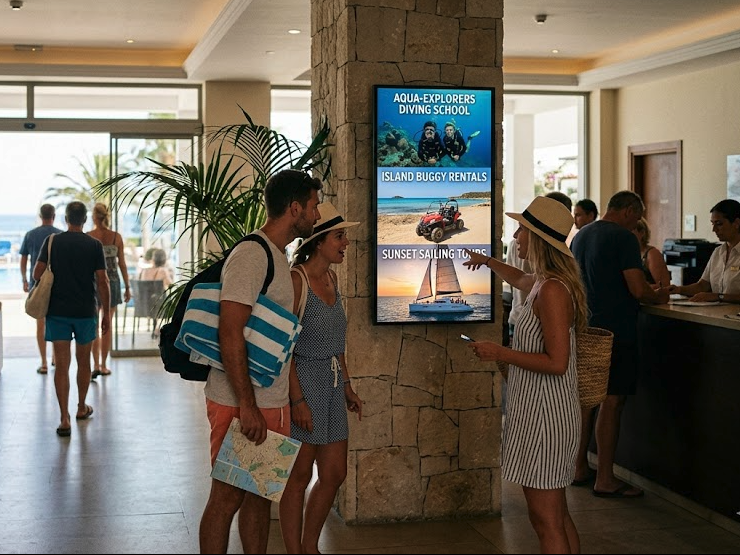
A local ad network in a tourist town (DOOH)

In UK tourist towns and seaside resorts, local businesses pay well to be seen by visitors. With digital signage you build your own Digital Out of Home (DOOH) network without owning a single billboard.

StrategyPlace screens for free in busy spots like hotel lobbies, cafés and visitor centres. You earn money by selling ad space ("airtime") on those screens to local attractions, tour operators, restaurants and hire shops.
Revenue modelAd-space subscription revenue
The numbers
  • Each screen runs a 10-spot ad loop
  • Sell each spot at £35/month
  • Per screen: 10 advertisers × £35 = £350/month
  • Initial hardware paid back in roughly 2 months
Best forSomeone in a tourist town who knows local business owners. Closest to passive income once a screen is live and the slots are sold.
3

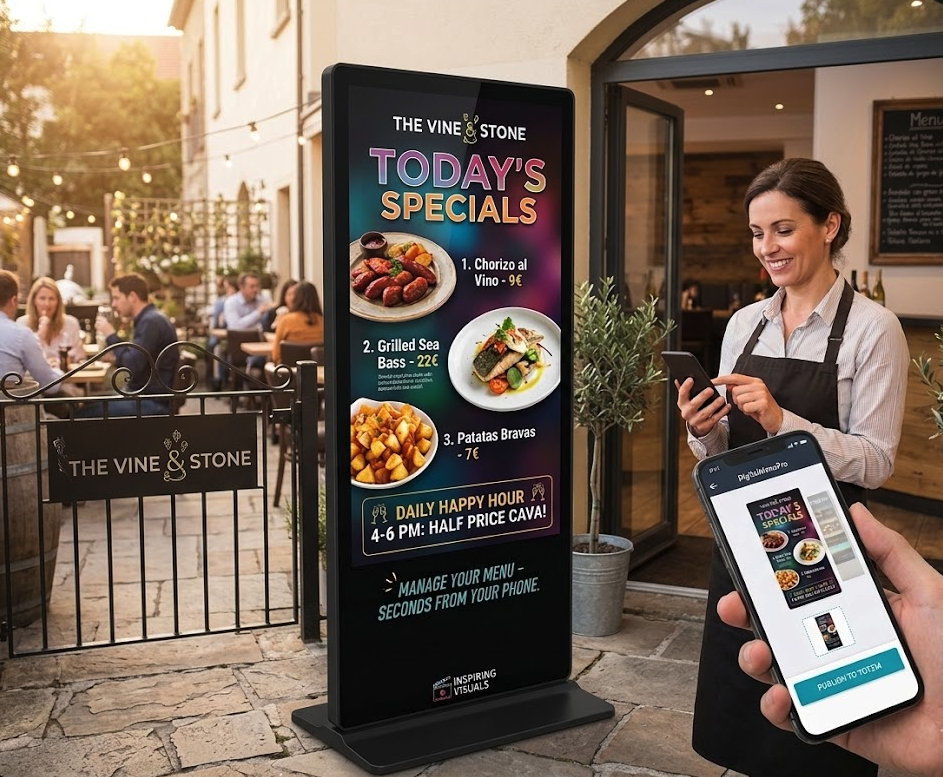
Digital menu boards for high-street cafés and takeaways

Local cafés, takeaways and pubs spend real money every year reprinting menus. A digital screen fixes that for good, and it makes them stand out from every other shop on the street.

StrategyOffer a turnkey "done-for-you" package. Mount the screen on the wall, set up the CMS, and make sure the owner can change the daily specials or limited-time offers from their phone in 30 seconds.
Revenue modelDone-for-you package (high one-time margin)
The numbers
  • Cost: ~£550 (32" display + heavy-duty wall mount + setup time)
  • Sell installed: £1,570 (includes installation + first content load)
  • Goal at 2 sales/month: £2,040 net profit/month
Best forSomeone who actively prospects. You'll need to walk into cafés and takeaways with a demo unit. Cash flow is strong from day one but it's not passive.
4

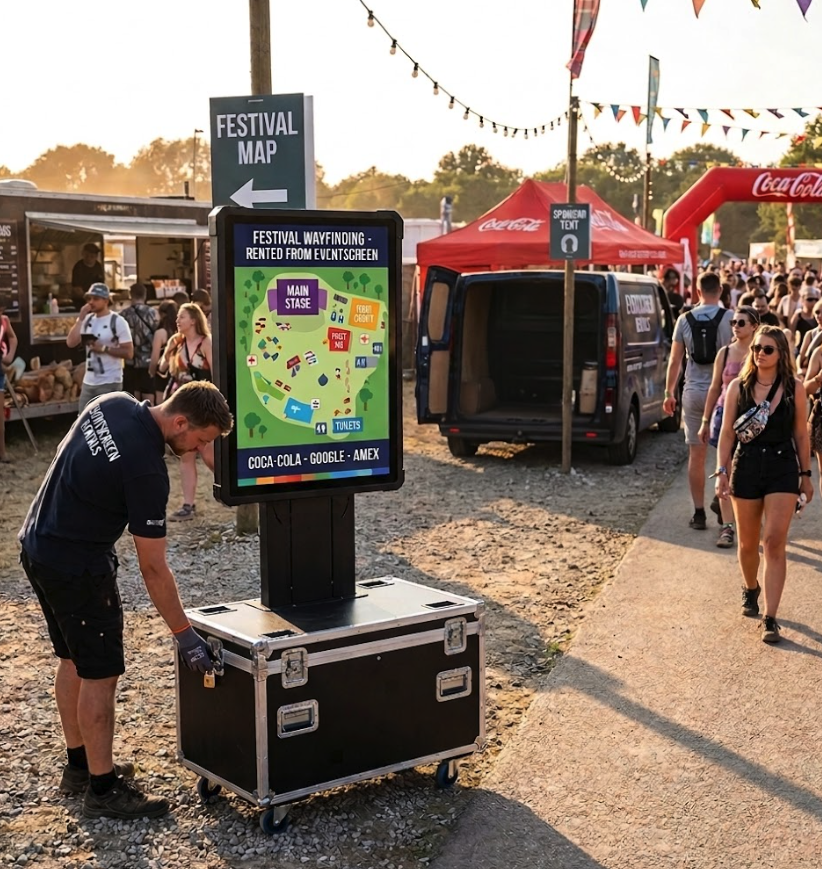
Digital signage hire for festivals and trade shows

For one-off events, buying a screen is overkill. But the demand for professional digital wayfinding and sponsor branding at UK festivals and trade shows is real. Hire fills that gap.

StrategyBuild a small fleet of mobile displays on heavy-duty floor stands. Hire them out by the day or weekend to local festivals, business conferences and pop-up markets, including delivery, setup and collection.
Revenue modelHardware-as-a-Service (day/weekend hire)
The numbers
  • Investment: ~£1,910 for a fleet of 3 displays
  • Hire: £210/screen/day (delivery + setup + content loading included)
  • Goal at 2 events/month, 2 screens each: £840/month
Best forSomeone who's good with logistics and doesn't mind early mornings hauling screens to event venues. Scales well once you have a steady network of event organisers.

What does it cost to get started in the UK?

So how much does this cost to get going in the UK? Less than you'd expect for a B2B business, because you're not opening a shop or paying a lease.

Yes, you're reading that right. The bare minimum is £1,215. You're not manufacturing anything. You're buying a few sample displays from a Chinese factory at £195 (32-inch) to £650 (86-inch flagship), paying shipping, duty and VAT, and reselling them locally at 3-4x markup.

Your biggest expense is stock, not equipment or premises. You work from home, meet clients at their business, and ship straight from the supplier for larger orders. That's why the cost table looks small. The work is in finding customers, not in building anything.

ItemLow EstimateHigh EstimateNotes
Initial Inventory (3-5 units)£810£2,050Sample displays for demonstrations and quick delivery
Sea Freight, Import Duty & VAT£170£510Shipping, customs duty and import VAT on your first stock
Business Registration & Admin£130£340Sole trader registration with HMRC or a limited company at Companies House, plus accounting setup
Insurance£65£170Public liability and product liability insurance
Marketing & Website Setup£40£165Basic website, business cards and first adverts
Total£1,215£3,235
Tip

Start with 2-3 sample units, not 10. Don't order a fleet before you've sold your first display. Keep your initial outlay under £1,700 until a paying customer commits.

What equipment do you actually need?

Cost is one thing. What you actually buy is another. Here are real Alibaba listings to start from. Check each supplier's rating and order history before you order.

Start with the entry-level 32" display so you can prove the model with £195 of stock risk per unit. The 86" flagship is for event hire, estate agent window displays and shopping-centre projects. The accessories below fill the gaps: an Android media player if your display has no built-in OS, and a rolling floor stand for events and showrooms. For remote management you add a cloud CMS subscription (see the FAQ).

MWE 86-Inch 4K LCD Floor Standing Digital Signage Display

MWE 86-Inch 4K LCD Floor Standing Digital Signage Display

£650

4.9
Shenzhen City Marvel Technology Co., Ltd.
✓ VerifiedTrade Assurance11 yrs
View on Alibaba
DisplayVETO

VETO 32" Android LCD Floor Standing Digital Signage Kiosk

£195

VETO
View on Alibaba
Media PlayerShenzhen Refee

4K WiFi Android Digital Signage Media Player Box

£70–£165

Shenzhen Refee
View on Alibaba
Mount HardwareLUMI

LUMI Rolling TV Stand for 37-86" Screens

£25 (100+ units)

LUMI
View on Alibaba
Before you order

Ask every supplier for CE or UKCA marking and the declaration of conformity. CE marking is currently accepted in Great Britain for most electrical products. No paperwork means no commercial installation, no insurance cover, and a useless display sitting in your garage.

What will you actually pay after shipping, duty and VAT?

The Alibaba listing price is just the start. By the time the display reaches your door, you've also paid sea freight, import duty, import VAT, a customs agent and inland delivery. Here's what one 86-inch unit costs landed in the UK.

All amounts are converted from euro supplier and freight quotes at 1 EUR = 0.85 GBP and rounded. Duty and VAT are worked out on those converted figures.

CostEstimateNotes
Product (1 unit, sample price)£650Direct from Shenzhen City Marvel
Sea freight (LCL, China to Felixstowe or Southampton)£130-£255Order 3+ units to drop the per-unit rate
Import duty (up to 14%, commodity code 8528 59)£109-£12714% on product plus freight. Monitors under 8528 52 are 0%. Check the code on the UK Trade Tariff or with your customs agent
Import VAT (20%)£178-£20620% on product, freight and duty. A VAT-registered business can usually reclaim it
Customs agent and port handling£85-£150Flat fee per shipment
Inland delivery (port to your address)£50-£100Less if you're near the port
Total landed cost£1,202-£1,488

If you're VAT-registered and reclaim the import VAT, your real cost drops to about £1,024-£1,282. UK distributors charge far more for a comparable 86-inch panel. You land it for under £1,500 and resell installed at a profit. That's the whole business model on one table.

Margin reality

40-60% margins sound too good to be true. They're not. You're cutting out 2-3 middlemen. The factory in Shenzhen sells the display for £340. A distributor marks it up to £1,020. A reseller marks it up to £1,700. You skip both and sell direct at £1,530. Everyone's happy except the middlemen.

What are the risks and the advantages?

The numbers are honest. But every business has risks. Before you send money to a Shenzhen factory, here's what's working in your favour and what could bite.

Strengths

  • 40-60% margins from importing Chinese displays at £510-£770 FOB and selling below UK distributor prices
  • Low MOQ under 10 units lets you test samples without a big capital commitment
  • B2B customers want quick delivery, so stock on hand beats dropship competitors
  • Technical know-how is a barrier: panel grades, brightness specs and CMS setup
  • Recurring revenue from installation services and content management subscriptions

Weaknesses

  • £810-£2,050 inventory per 3-5 unit batch ties up working capital
  • Quality control risk with A+ versus refurbished panels, so you must check suppliers
  • Sea freight lead times of 30-45 days slow down restocking
  • CE or UKCA paperwork checks before every new supplier or model
  • Technical support load for CMS setup and hardware faults

Opportunities

  • Cafés, takeaways and fast-food outlets switching to digital menu boards
  • Shops refreshing their screens every 5-7 years, creating replacement cycles
  • Offices, hotels and venues upgrading wayfinding to touchless digital screens
  • Digital out-of-home advertising growing beyond traditional retail, from tourist towns to festivals

Threats

  • Amazon Business and Alibaba selling direct to buyers and cutting out resellers
  • Big brands like Samsung and LG launching direct-to-customer programmes
  • Changes to duty on Chinese electronics affecting your costs overnight
  • LED panel oversupply pushing factory prices down faster than retail prices
  • An economic downturn delaying business spending on display technology

How do you find your first customers?

The product is real and the margins are there. The only thing left is finding the first buyer.

This isn't a footfall business. You're not waiting for customers to walk in. Your job is to spot the right local businesses and start a conversation. The signs below tell you whether your area is a good fit and where to focus.

What to look for

  • You live near a busy high street or town centre with cafés, takeaways, shops and hotels. These are your target customers, and you can drop in for a 5-minute demo on a Tuesday afternoon.
  • Local cafés and takeaways still use printed menus or chalkboards. Every reprint costs them around £170 each time they change a price. Your digital menu board is £1,530 once.
  • Trade shows, food festivals or hospitality events run near you. You can demo a unit there for £425 instead of cold-calling 100 restaurants.
  • Your area has new retail or restaurant development (a new shopping centre, a regenerated high street). New venues need signage from day one.
  • Other signage resellers near you focus on large corporate clients. The small-business segment is wide open.

Walk away if

  • Your local market already has several signage resellers chasing small shops and cafés.
  • Most shops in your area are small family businesses with tight budgets and slow tech adoption.
  • You're far from Felixstowe or Southampton. Inland delivery adds 25-40% to your landed cost compared with competitors near the ports.
  • Local businesses are slow to adopt technology (rural areas, older customers). Your sales cycle stretches from weeks to months.
  • Big brands like Samsung or LG have direct sales reps covering your region with bigger marketing budgets.

How do you go from zero to first sale?

Ready to start? Here's the 12-week plan that takes you from zero to your first paying customer.

Each phase has 4-6 concrete actions. Don't skip ahead. The sample-order phase tells you whether the supplier is real and the panel is what they claim. Skip it and you risk landing a pallet of unsellable refurbished panels.

  1. Research & First Contact

    Week 1-2

    Pick a niche, contact suppliers, and meet your first prospects. Don't skip the prospect visits. That's where your pricing and your pitch come from.

    • Pick your niche (cafés and takeaways, high-street shops, estate agents, events) and learn what local businesses pay for signage now
    • Contact 3-5 Alibaba suppliers with verified/Gold status and ask for sample pricing and the CE or UKCA declaration of conformity
    • Visit 5-10 local businesses that still use printed menus, posters or chalkboards. These are your first prospects
    • Check who else sells digital signage near you and what they charge for installation
    • Register as a sole trader with HMRC or set up a limited company, and sort out public liability insurance (you'll be mounting heavy equipment on walls)
  2. Sample Order & Testing

    Week 3-4

    Order 1-2 samples and turn your home or office into a working demo while you wait. By the end of week 4 you can walk into any café with a phone full of proof.

    • Order 1-2 sample units from your top supplier. Test brightness, build quality and CMS compatibility
    • Set up a demo display at home or in your office with a café menu template running
    • Build a simple website or portfolio page showing the display in action (photos and pricing)
    • Open accounts with 2-3 CMS platforms (most offer free trials) and learn the interface
    • Prepare your pitch: cost comparison against printed menus, plus a demo video on your phone
  3. Setup & First Sales

    Week 5-6

    Now you sell. Start with the warm prospects you've already met, close one paid deal, and order stock based on real demand instead of guesses.

    • Approach your first 5 prospects. Start with cafés you already visit, as you have a relationship
    • Offer a free 1-week demo to your strongest lead: install it, load their menu, let them try it
    • Close your first paid sale. Aim for £1,280-£1,700 installed with 1 month of free CMS support
    • Order your first small batch (3-5 units) based on early interest. Don't overstock
    • Set your support pricing: £25-£45/month per screen for CMS and remote support
  4. First Installations

    Week 7-8

    Stock has landed. Install, photograph, post and ask for referrals. Every install is a marketing asset.

    • Install, photograph everything, and ask the owner for a testimonial or Google review
    • Create a before/after portfolio: printed menu versus digital display
    • Post installation photos on your Google Business Profile, LinkedIn and local Facebook groups
    • Ask your first customer for 1-2 referrals. "Do you know another café owner who'd want this?"
  5. Scale

    Week 9-12

    You have proof, photos and a working pitch. Now double down on what converts and go after multi-site deals, where revenue jumps.

    • Analyse: which niche converts fastest? Which pitch works? Double down on that niche
    • Set up recurring CMS subscriptions. This is where monthly income starts
    • Negotiate better per-unit pricing with your supplier now that you have order history
    • Hire a part-time installer or partner with a local AV or IT firm for installations
    • Build a "digital signage package" page on your website with clear pricing tiers
    • Target a local chain (3-5 sites) or an estate agency group. Multi-site deals are where revenue jumps
Want this whole plan as a PDF?

Run the calculator above with your own numbers, then download a personalised starter kit with a 90-day checklist, supplier vetting questions and the cost breakdown for your scenario.

Interactive tool

Run your own numbers

You've seen the cost gap and the four business models. Now run the numbers for your own plan.

Adjust units sold per month, average selling price and landed cost per unit to match the model you're considering. The calculator shows your monthly revenue, gross margin and break-even at the bottom. The defaults assume the café menu-board model: 4 sales a month at £1,550 each, £650 landed cost.

Digital Signage Profit Calculator

Your Numbers

£
£
£

Projections

Est. Monthly Revenue£6,200
Est. Monthly Profit£3,600
Gross Margin58%
Break-even1 month
Get your free Starter Kit

Your numbers, a 90-day checklist, cost breakdown, and supplier guide.

Personalized PDF based on what you just typed in. Direct download. We save your email so we can send updates if you opt in below.

No spam. Unsubscribe anytime.

Still have questions?

Last few questions before you decide. These are the ones we hear most often from new UK resellers.

Between £1,215 and £3,235. That covers 3-5 demo units, freight, import duty and VAT, registering as a sole trader or limited company, insurance, and a basic website. Inventory is the biggest cost. You can work from home and meet clients at their premises.

Gross margins of 40-60% are typical when you import directly from Chinese manufacturers. On a display you buy for £650 landed and sell installed for £1,550, you keep about £900. Your net margin depends on installation time, travel costs, and whether you offer ongoing CMS support.

A basic 32-inch commercial display starts around £215-£340 from Chinese manufacturers. A 55-inch or 86-inch 4K floor-standing unit runs £510-£680. One 86-inch display landed in the UK costs about £1,202-£1,488 once you add sea freight, import duty, import VAT, customs agent fees and delivery. If you're VAT-registered you can usually reclaim the import VAT, which brings it to about £1,024-£1,282. UK distributors charge a lot more for the same panels.

Most suppliers accept custom branding (logo, boot screen) from 5-10 units. A fully custom housing design or colour usually needs 20-50 units. For your first orders, stick with standard colours and add your branding through the CMS software instead. A branded screen saver or startup animation costs nothing.

Indoor commercial spaces need 350-500 nits minimum. For shop windows or semi-outdoor spots, you need 700+ nits. Direct sunlight (outdoor kiosks, bus stops) needs 1,500+ nits. Always ask the supplier for the exact nit rating. "Commercial grade" means different things to different factories.

Yes. The display needs CE or UKCA marking. CE marking is currently accepted in Great Britain for most electrical products. Ask the supplier for the declaration of conformity before you pay, and check the unit runs on 230V with a UK plug or a UK-compliant power lead. Without the right marking your customer's insurance may not cover it.

Up to 14%. Standalone signage screens usually fall under commodity code 8528 59 at 14%. Screens classified as computer monitors (8528 52) are 0%. Budget for 14% on product plus freight as the safe estimate, and check the code on the UK Trade Tariff or with your customs agent. Import VAT of 20% comes on top, which a VAT-registered business can usually reclaim.

Standard warranties run 1-2 years for parts, but that usually assumes 12-16 hours a day. If your customer runs the display 24/7 (common in hotels, stations, takeaways), ask the supplier directly. Some offer extended commercial warranties for a small premium. Get it in writing before you order.

Most commercial displays support USB playback for basic slideshows and videos. For scheduled playlists, remote updates and multi-screen management, you need CMS software. USB-only works for a single screen showing a fixed menu. For anything more, and for the recurring revenue, use a cloud CMS.

Samples (1-3 units): 5-10 working days production plus 30-45 days sea freight, or 7-10 days air freight at 3-4x the cost. Bulk orders (10+ units): 15-25 working days production plus shipping. Always ask for the current lead time, as it varies by season. Chinese New Year (January-February) adds 2-4 weeks to everything.

Most displays come with basic built-in media playback. Cloud CMS platforms like NoviSign, Yodeck or Rise Vision cost about £5-£15 per screen per month. Some suppliers bundle 1-2 years of CMS access with the hardware. The CMS subscription is a business opportunity for you. Offer it to customers as a monthly service on top of the hardware sale.

Panel grade sets colour accuracy and defect tolerance. A+ panels have zero dead pixels and the best colour uniformity. These go into Samsung and LG branded displays. A-grade panels may have 1-3 minor defects but look fine for menu boards and signage. B-grade panels are much cheaper but may show visible colour differences. Always ask the supplier to state the grade. If they can't or won't tell you, that's a red flag.

Search demand

Other searches in this space

Beyond the head terms above, here are the long-tail and use-case queries the same buyers run on Google. Updated November 2026.

90
searches / month
"digital signage uk"
40
searches / month
"digital signage totem"
20
searches / month
"digital signage business"
20
searches / month
"digital signage hire"
10
searches / month
"digital signage stand"
↓ Download CSV

Free to cite with attribution to FoundSquare and a link back to this page.

Sources

Product prices come from real Alibaba supplier listings (sample / 1-unit prices, never bulk MOQ). Industry figures are cross-checked against the sources below. Numbers are reviewed and updated at least once a year.

  1. DataForSEO — DataForSEO, UK search volumes, Sep 2026. Google Ads monthly search volumes and 12-month trend for UK digital signage keywords
  2. UK Government — UK Trade Tariff (commodity code 8528 59). Import duty rates for monitors and display screens (8528 59 and 8528 52)
  3. European Commission — CE Marking Requirements for Electronic Equipment. CE marking requirements, currently accepted in Great Britain for most electrical products
Share

Get Your Personalized Business Plan by Email

We'll send you a PDF with your calculator results, equipment recommendations, and step-by-step guide.